
AI Capabilities and Limitations – What Today’s AI Can and Cannot Do? If you listen carefully, you can hear the hum of artificial intelligence everywhere now, in subway ads promising the future of everything, in corporate memos that read like science fiction written by middle management, and in late-night conversations where someone inevitably asks whether machines are about to outthink us. Today, AI occupies a strange place in public imagination: we treat it with the awe reserved for gods and the suspicion reserved for politicians.
But underneath the marketing and mythology lies a quieter truth about what today’s systems actually do, and, just as important, what they decidedly cannot. The gap between these two categories is wide enough to drive a self-driving car through, though the vehicle would still require a safety driver and probably a waiver form.
Modern language models can draft emails, summarize reports, offer historical trivia, and write short stories in a passable facsimile of your favorite author. They can glide between languages, tones, and rhetorical poses like well-trained impressionists. The effect is impressive, though not mystical; they are, at heart, intricate pattern machines.
AI capabilites and limitations!
They can sound insightful without ever experiencing insight.
These systems now accept text, images, audio, and the occasional shaky cellphone video, folding them into a single interpretive engine. Show an image of a crowded kitchen, and the model will reliably identify the toaster, the spilled flour, and the dog eyeing the counter.
But give it a real kitchen, one with moving people, clattering pans, and a persistent smell of burnt onions, and the illusion falters. AI is competent at snapshots, not life.
In domains where rules are clear and data is abundant, radiology scans, fraud detection, warehouse logistics, AI performs with a kind of superhuman steadiness. It doesn’t tire, doesn’t blink, and doesn’t complain about night shifts.
This reliability, however, fades the moment the task turns ambiguous or unstructured. The machines handle the routine beautifully; the unusual still belongs to us.
There is a certain poetry in watching an algorithm sift through spreadsheets, triage emails, or schedule meetings with serene indifference. Tasks that humans typically approach with sighs and caffeine become instantaneous.
Yet automation is not autonomy. The systems do not decide what the work should be, they only accelerate the work we assign.
AI can sketch, compose, animate, and illustrate, but what it produces is closer to an echo than a revelation. It accelerates brainstorming, fills in blanks, and offers convenient approximations of creative thought.
The spark, the restless, irrational, deeply human impulse to make something new, remains outside its grasp.
Perhaps the most quietly persistent misunderstanding about AI is the assumption of comprehension. Machines now speak so fluidly, so confidently, that people forget confidence is a parlor trick.
Ask an AI to generalize a simple pattern across an unfamiliar context, and you’ll often get something that feels more like improvisation than inference. Give it a novel situation, a citizen asking a question nuanced by politics, or a child offering half-formed logic, and the model’s limitations become apparent. Human cognition lives in ambiguity; machines struggle to tolerate it.
Despite advances in robotics and vision, current AI systems do not possess anything like human situational awareness. Their “eyes” are fast, but their understanding is brittle. Autonomous machines still need layers upon layers of safeguards, because the world delights in unpredictability: a stray plastic bag, a rogue cyclist, a poorly painted lane marker.
The machines know only what they’ve seen before. Life rarely cooperates.
Language models are spectacularly good at being plausible. Unfortunately, plausibility is not the same as accuracy. They invent references, fuse facts, and hallucinate details with the confidence of a bar storyteller. When you ask them for the truth, they give you the shape of truth, a silhouette, not the substance.
They require verification, the way a rumor does.
AI cannot decide how to allocate hospital beds, rewrite a nation’s law, or resolve a moral dilemma. It has no stake in the outcome and no concept of harm. It cannot be held accountable. It cannot feel shame, remorse, or duty. Any attempt to outsource decision-making to a machine is, ultimately, an attempt to outsource responsibility, a temptation societies would do well to resist.
Despite popular anxieties, today’s models are not sitting in datacenters plotting self-improvement. They cannot redesign their architecture, retrain themselves, or pursue independent goals. Every advancement still requires human intention, human engineering, and human oversight.
AI may run at astonishing speeds, but it follows a trail we lay.
Artificial intelligence today is a remarkable tool, maybe the most remarkable we’ve ever built, yet it remains a tool. Not a mind, not a species, not a successor. Its power lies in amplification: of labor, of ideas, of mistakes.
Understanding what it can and cannot do is not an act of cynicism but of stewardship. The real magic of AI emerges when humans work with it clear-eyedly, neither dazzled nor frightened, but curious.
And perhaps that is the irony: the more capable our machines become, the more clarity we need about our own intelligence, what it is, how it works, and why it matters.
FAQ About AI Capabilities and Limitations
What can AI actually do today?
AI excels at pattern recognition, data processing, language generation, translation, and classification tasks. It performs best in predictable environments with clear rules and large datasets.
What are the main limitations of AI?
AI struggles with ambiguity, emotional understanding, moral reasoning, common sense, and novel situations that fall outside its training data.
Does AI truly understand what it says?
No. AI does not understand meaning. It generates text based on statistical predictions, not real comprehension or awareness.
Why does AI hallucinate or give incorrect answers?
AI hallucinations occur when a model outputs information that sounds correct but is actually false. This happens because AI predicts patterns, not facts.
Can AI make ethical or high-stakes decisions?
No. AI lacks moral judgment, responsibility, and an understanding of harm. High-stakes decisions must remain under human control.
Is AI capable of being genuinely creative?
AI can mimic creativity by remixing patterns from its training data, but it does not originate ideas or experience the creative spark humans possess.
Is AI autonomous or self-improving?
No. Current AI cannot redesign itself, pursue goals, or self-improve without human intention, engineering, and oversight.
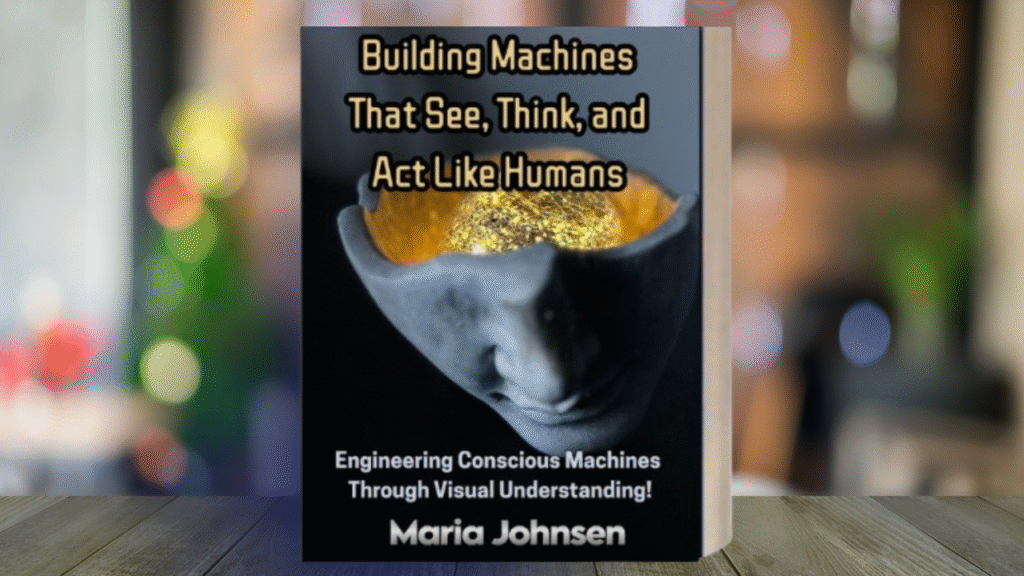
Building Machines That See, Think, and Act Like Humans
Featuring full-color illustrations, advanced mathematics, and cutting-edge topics such as spiking neural networks and embodied cognition, this book provides a visionary roadmap for creating conscious machines.
Ideal For:
- Researchers aiming to advance AI perception and reasoning
- Engineers building human-like visual intelligence systems
- AI innovators designing conscious machines