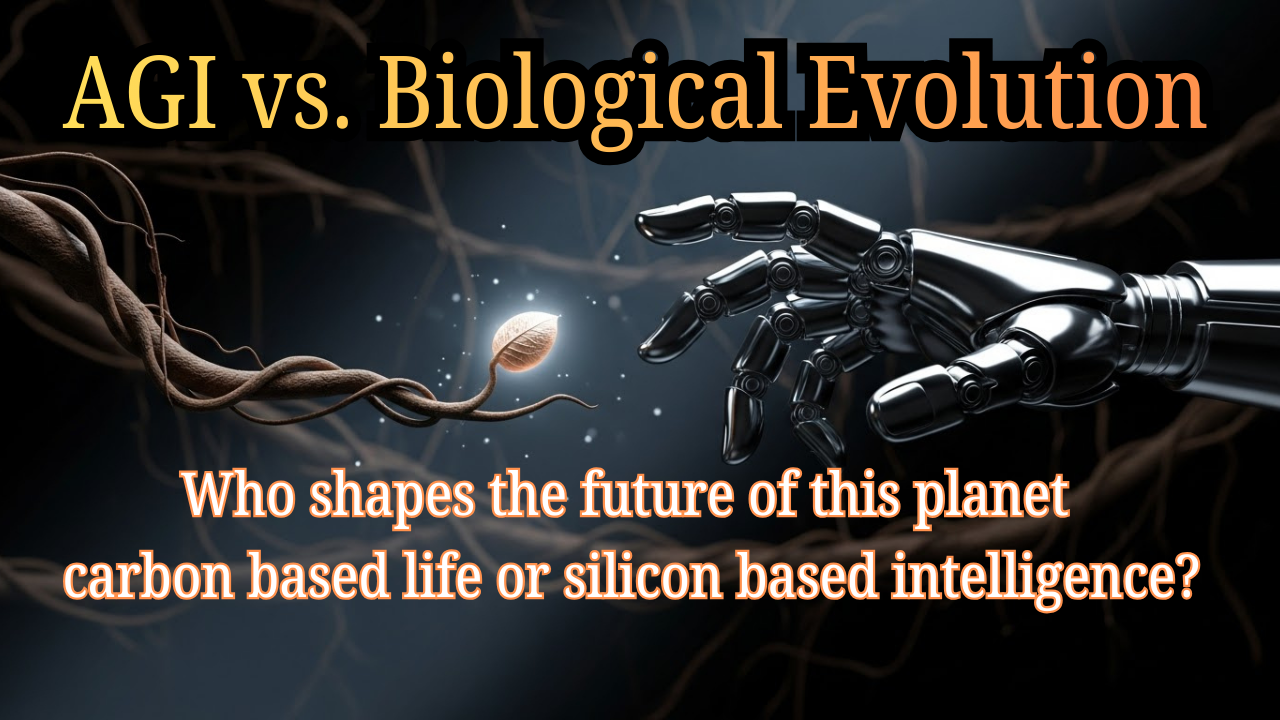
AGI vs. Biological Evolution: Could machines surpass humanity’s knowledge in months while humans took millennia to build it?
For millennia, human civilization has been a slow accumulation of knowledge. We build, experiment, and learn, often without fully grasping the sum of what has come before. Every generation contributes a brick to the vast edifice of human understanding, art, science, language, and technology, layered patiently over centuries. This is evolution at work: deliberate, incremental, measured by time.
Artificial Intelligence, however, operates at a different cadence. Today’s AI is narrow, specialized, and astonishingly capable within its domains. It can translate languages, analyze medical images, generate text, and detect patterns that would elude even the most brilliant human mind. It does not sleep, tire, or forget, and it can process in months what humans might labor over for decades. It is not conscious, it cannot feel, and it cannot reason with the flexibility of a human, but it hints at a future where intelligence accelerates at a speed incomprehensible to us.
The contrast is stark. Humans build knowledge slowly, constrained by biology, the limits of memory, and the length of a lifetime. AI, by contrast, can ingest the entirety of human-written knowledge and synthesize it in the blink of geological time. Centuries of accumulated insight could, in theory, be compressed into months of computation. Where humans stumble, experiment, and fail, AI iterates efficiently, improving with each cycle. The acceleration is dizzying, almost unimaginable.
Yet speed is not wisdom. Human intelligence is inseparable from experience: consciousness, empathy, moral reasoning, and creativity. We invent meaning, debate values, and wonder at the world around us. Machines may surpass us in sheer processing power, but they do not live in the world. They do not struggle, hope, or dream. They do not ask why. They do not marvel.
Still, one cannot ignore the possibilities. If AI were ever to approach General Intelligence, the hypothetical stage at which a machine could perform any intellectual task a human can, the pace of knowledge acquisition could eclipse the slow march of human civilization. Decades of research, centuries of scholarship, and millennia of cumulative discovery might be digested, connected, and expanded upon in mere months. The next leap in understanding could come not from human effort, but from silicon architectures designed by humans, operating at a speed our brains cannot match.
This raises a profound question: who will shape the future of this planet? Carbon-based life, painstakingly evolved over millennia, or silicon-based intelligence, accelerating in ways we can scarcely predict? The stakes are unprecedented. Civilization has always been measured by the careful layering of knowledge and experience. Machines, if guided, or left unguided, could rewrite the very pace of progress, challenging our assumptions about authority, creativity, and survival itself.
AGI vs. Biological Evolution: Who Will Shape the Future?
Even now, as AI remains specialized, the contrast is instructive. Humanity moves with deliberation, informed by history, ethics, and trial and error. Artificial intelligence moves at the speed of computation, compressing centuries of insight into months of operation. The collision of these two tempos, human patience and machine acceleration, may define the next era of intelligence on Earth.
The story is not yet written. AI has not surpassed human cognition, and General Intelligence remains speculative. But the trajectory is clear: if machines ever reach the level of adaptable, independent reasoning, they will force a reevaluation of our role in shaping the future. The slow, reflective march of humanity may meet a rival that moves in microseconds, learning and evolving in ways our biology cannot.
The question, then, is unavoidable, urgent, and unsettling: when it comes to shaping the future of this planet, will it be carbon-based life, honed by millennia of evolution, or silicon-based intelligence, forged by design and speed? Humanity may be the author of its own successor, and the pace at which the next chapter unfolds may leave us both awed and unsure.


 Are you ready to see beyond the current buzz surrounding AI? While Large Language Models (LLMs) and generative tools impress us daily, they’re just the tip of the iceberg. AGI – Beyond Current Models offers a profound exploration into Artificial General Intelligence (AGI), the truly human-like intelligence that promises to redefine our world. The book contains 41 chapters and 489 pages.