

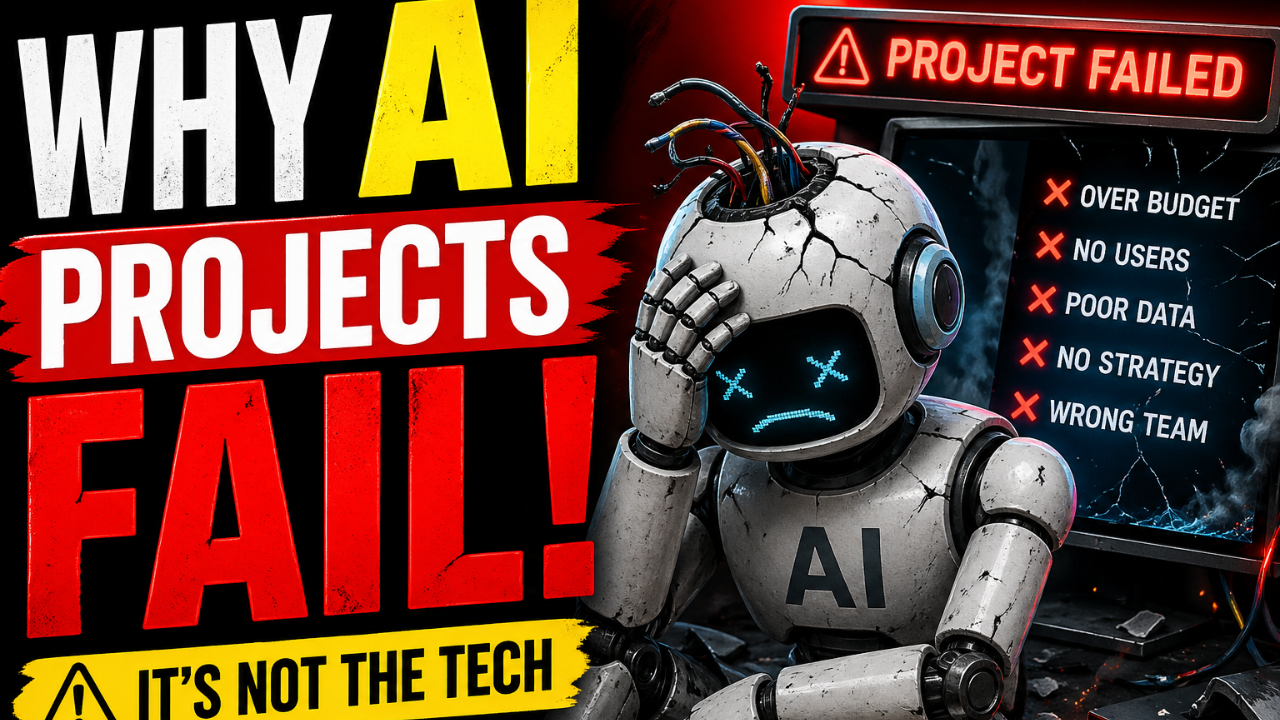
AI projects fail when companies chase hype over real problems, struggle with poor data, and fail to integrate solutions into workflows. After looking closely at more than a hundred teams, what stands out is this: most AI projects don’t collapse because the technology is inadequate. They falter because the story around them was never quite right to begin with.
The point, put plainly, is this: most AI projects fail for reasons that have very little to do with artificial intelligence.
After watching how these projects unfold across many teams, a pattern becomes hard to ignore. Companies don’t usually stumble because the models are too weak or the tools too limited. They stumble because they misunderstand what they’re building, why they’re building it, and what it takes to make it work in the real world.
What causes AI projects to fail?
At the center of the problem is a kind of misplaced starting point. Many organizations begin with the idea that they need AI, as if it were a box to check rather than a tool to use. The conversation starts with technology instead of a problem. And when you begin that way, everything that follows becomes uncertain. Without a clear objective, there is no reliable way to measure success. The project can move forward meetings can be held, prototypes can be built, but it drifts, never quite landing anywhere meaningful.
Then comes the issue of data, which is less glamorous but far more decisive. AI depends on data the way a story depends on facts. If the underlying material is incomplete, inconsistent, or poorly structured, the results will reflect that. Many teams assume they have what they need, only to discover that their data is fragmented across systems, filled with gaps, or shaped by years of informal processes. The model doesn’t fail dramatically; it produces answers that seem reasonable but cannot be trusted. That quiet unreliability is often what brings a project to a halt.
Even when a system appears to work, another challenge emerges: the distance between a controlled demonstration and everyday use. In a test environment, conditions are tidy. Inputs are predictable, and outcomes can be carefully evaluated. But outside that environment, things become messier. Data arrives in unexpected forms. Users behave in ways no one anticipated. Systems that were never designed to work together must suddenly do so. What once looked polished begins to strain under the weight of reality. Many projects stall at this stage, not because they lack potential, but because they cannot adapt quickly enough.
Why is AI hard to implement successfully?
Ownership is another quiet fault line. AI projects often exist in a space between departments. They are technical, but their impact is business-wide. When no single person or group is clearly responsible for the outcome, momentum fades. Decisions take longer. Priorities shift. The project continues, but without direction. It becomes something that is discussed often but driven by no one in particular.
Expectations, too, play a significant role. AI has been surrounded by a great deal of excitement, much of it justified, but not always grounded. There is a tendency to expect sweeping transformation to believe that a single system will dramatically change how work is done. When the results turn out to be incremental, even if they are useful, they can feel disappointing. A tool that saves time or improves accuracy may be overlooked because it does not appear revolutionary. In this way, success is sometimes mistaken for failure simply because it does not match the original promise.
And finally, there is the matter of integration. A model, no matter how sophisticated, is only one part of a larger system. It has to fit into existing workflows, connect with other tools, and make sense to the people who use it. If it disrupts more than it helps, it will be set aside. This is not a rejection of the technology itself, but of the friction it introduces. People tend to rely on what is familiar and reliable, even if it is less advanced.
Taken together, these issues point to a broader conclusion. AI projects are not just technical efforts; they are organizational ones. They require clarity of purpose, attention to detail, and a willingness to adapt. They depend as much on communication and alignment as they do on algorithms.
The teams that succeed tend to recognize this early. They focus on specific, well-defined problems. They invest time in understanding and preparing their data. They accept that progress will be gradual, not instantaneous. And they make sure that someone is clearly responsible for turning the idea into something that works in practice.
So the point is not simply that AI projects fail. It is that they fail in ways that are predictable and, to a large extent, avoidable. The technology itself is rarely the limiting factor. More often, it is the way people approach it, what they expect from it, how they organize around it, and whether they are prepared to do the less visible work required to make it useful.
Understanding that does not guarantee success. But it does change the odds.