As AI-powered wearables start to move into everyday life, a common reaction is: “How is this any different from social media? ”After all, platforms like Instagram and WhatsApp already collect vast amounts of personal data.
But that comparison misses something deeper.
This isn’t just about how much data is collected. It’s about how that data comes into existence, when it’s captured, and whether you, or anyone around you, fully realizes it’s happening.
To understand that, it helps to compare social media with devices like Ray-Ban Meta Smart Glasses.
Intentional Interaction vs Ambient Presence
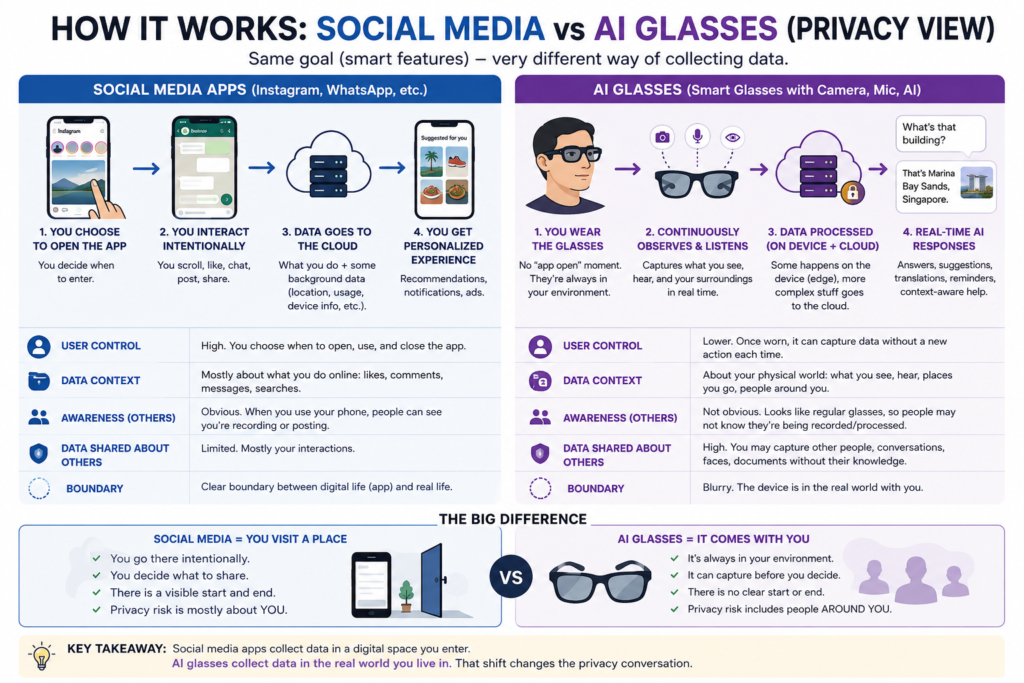
At the core of social media is intent.
You open an app. You scroll. You post. You message. Even if background tracking exists, everything begins with a conscious action. AI Glasses changes that model.
Instead of requiring interaction, it exists alongside your daily life. Smart glasses are designed to be worn continuously, introducing the possibility of ambient data capture, where audio, visuals, and context are collected simply as you move through the world.
The shift is subtle but powerful:
From “I’m choosing to share”→ to “This might be captured anyway.”
Opt-In Digital Space vs Embedded Physical Capture
Social media lives in a defined digital space. When you open Instagram, you know you’ve entered a platform. AI Glasses removes that boundary.
The device operates in the same physical environment you do. What you see, hear, and experience can also become input for the system. There’s no clear “session”, just ongoing presence.
Data Generation: User-Initiated vs Environment-Driven
On platforms like WhatsApp, data comes from user actions: messages, posts, uploads, reactions
With wearable AI, data can be “environment-driven”.
Devices like Ray-Ban Meta Smart Glasses may capture: what you’re looking at surrounding audio, real-world context
You’re still involved, but you’re no longer the sole trigger.
Awareness and Consent in Shared Spaces
Phones are visible. If someone records you, you usually know.
Wearable AI aka. AI Glasses is different.
Because these devices look like normal glasses, people around you may not realize when recording or processing is happening. That introduces questions around bystander awareness and consent, especially in public or shared environments.
Even the possibility of being recorded can change how people behave.
Ecosystem Integration and Continuous Data Flow
Both social media and wearable AI rely on cloud infrastructure. But wearable devices often depend on continuous connectivity to function fully.
With systems like Ray-Ban Meta Smart Glasses, captured data may be processed through companion apps and remote servers in near real time. That creates a tighter, more constant link between everyday life and digital systems.
A Real-World Experience: When Convenience Meets Control
This is where the theory becomes practical.
Take the newer Meta-powered glasses ecosystem, including products like Oakley Meta Vanguard AI Glasses.
Here’s the reality from firsthand use:
You can’t really use these glasses on your own terms. To get started, you’re required to:
– Install Meta’s companion app
– Grant access to photos, files, and storage
– Allow telemetry and system-level permissions
– Route core features (photos, video, audio, AI queries) through Meta’s servers
– There’s no simple Bluetooth-only mode.
– No true offline option.
– No local-only privacy setting.
In practice, that means the device doesn’t just capture moments, it depends on sending them through a broader ecosystem to function.
Where It Becomes a Deal-Breaker
For some users, that level of integration raises concerns.
When a device is always connected and tied to a centralized system, especially one operated by a company like Meta Platforms and led by Mark Zuckerberg, it can feel less like a standalone product and more like part of a larger data network.
There are also broader concerns people bring up (rightly or wrongly), including:
– how such data could be accessed through legal channels by agencies like the Federal Bureau of Investigation or Central Intelligence Agency
– how large-scale analytics companies like Palantir Technologies operate on massive datasets
To be clear: this doesn’t mean those scenarios are happening, but the architecture makes that level of data flow possible, and for some users, that alone is enough to walk away.
The Missed Opportunity
What’s striking is that many of these concerns could be reduced with simple design choices:
- local-only recording mode
- offline functionality
- direct Bluetooth media capture
- optional cloud sync instead of mandatory routing
Without those options, the device can feel less like something you fully control, and more like something you participate in.
Why This Changes the Conversation
This is ultimately why comparing social media to wearable AI falls short.
– Social media collects data when you engage.
– Wearable AI can collect data as you live. This is a new way of making money by capturing direct user data. You’re paying for a device that only works properly if you plug into Meta’s data ecosystem and that trade-off isn’t optional.
That difference reshapes expectations around privacy, control, and ownership.
Comparing Instagram and WhatsApp to devices like Ray-Ban Meta Smart Glasses or Oakley Meta Vanguard AI Glasses isn’t just a matter of scale, it’s a matter of design philosophy.
Social media is user-initiated and screen-bound.
Wearable AI is continuous, embedded, and environment-driven.