Business in 2026 demands stability over hustle, learn how to grow, market, and thrive without burning out or losing yourself. The prevailing diagnosis for contemporary distress is “burnout,” but the term feels too theatrical for what is actually happening. Burnout implies a blaze, an event, a collapse, a visible failure. What we are witnessing instead is closer to a liquidation. Assets sold off quietly. Interiors emptied. A person still operating, still punctual, still responsive to email, but no longer fully there. We have entered the age of the high, functioning ghost.
The modern worker presents a curious biological achievement: sustained productivity under conditions of permanent instability. There is a particular exhaustion that passes for competence, the fatigue of someone who has learned to perform efficiently while standing on a surface that never quite solidifies. This is not the panic of drowning. It is the steady, practiced motion of someone treading water who no longer remembers when land last existed, or whether it was ever real.
We are encouraged, often cheerfully, to “pivot.” The word suggests athletic grace, a clean rotation around a stable point. But the contemporary economy offers no axis. To pivot on a sliding tectonic plate is not strategy; it is balance control. When this constant recalibration fails to deliver the promised reward of security, the brain responds sensibly. It narrows, conserves and retreats.
Neurologically speaking, this is the triumph of the amygdala over the prefrontal cortex. When safety cannot be located, imagination becomes dangerous. Hope begins to feel fiscally irresponsible. The future, once a landscape of possibility, is reduced to a deadline. When people say they don’t know what comes next, they are not being coy. They are reporting a systems failure. The cognitive resources required to simulate a future have been reassigned to maintaining the present.
This helps explain our strange cultural fixation on the lottery and its digital descendants: the viral breakthrough, the algorithmic miracle, the overnight windfall. These pursuits are often dismissed as greed. They are better understood as appeals for mercy. The jackpot promises release from the endless requirement to justify one’s existence. To have “enough” is to be granted permission to stop explaining why you deserve to take up space.
There is a particular harshness in how we regard those who opt out, who look at the low, wage, high, stress labor market and decline to participate. We call it entitlement or laziness, or rebrand it as a trend. Rarely do we recognize it as a rational assessment. If survival demands the surrender of what remains of one’s autonomy, and the reward is merely continued survival, the arithmetic stops working.
The tragedy of the moment is not exhaustion itself, but the way we have moralized ascent and medicalized stillness. Progress is treated as virtue; equilibrium as pathology. For a growing number of people, the most subversive act is no longer innovation or hustle. It is the quiet refusal to vanish.
What we are waiting for is not success. It is safety. We are waiting for a world in which rest is not a prize earned through prolonged strain, but a basic condition of being human. Until then, we continue treading water, competently, discreetly, and largely alone.
The Architecture of the Floor
To belong to the precariat, this hybrid class defined by precariousness rather than ownership, is to live without a reliable horizon. Where the mid, century social contract resembled a staircase, today’s version functions more like a treadmill, regulated by invisible systems and indifferent metrics.
The precariat is not limited to gig workers or delivery drivers. It includes adjunct professors, freelance creatives, contract professionals, anyone whose labor floats free of durable institutions. What unites them is a fragmented identity. When work is reduced to a sequence of tasks, the self follows suit. One is no longer a person with a profession, but a modular bundle of services, perpetually ready for extraction.
The Neurological Siege
Stability, in physiological terms, is the nervous system’s ability to enter a parasympathetic state, the condition in which the body can rest, digest, and repair. Chronic precarity keeps the system locked in sympathetic overdrive. Fight or flight becomes a lifestyle.
This is where the idea of “stabilization” begins, and where most contemporary advice fails. Another optimization tool or stricter routine only deepens the error by treating the human being as a miscalibrated machine. Real stabilization involves constructing artificial floors where none are provided, deliberate structures of safety in an otherwise unbuffered life.
Business in 2026 – Strategies for the Landing
If survival mode contracts the horizon, stabilization expands it slowly, almost imperceptibly. It requires a redefinition of maintenance.
The Decoupling of Worth. The first step is severing the link between output and value. In a task, based economy, it is easy to see oneself as an hourly commodity. Stabilization demands the creation of non, monetized spaces, areas of life where existence is not justified by productivity.
The Search for Micro, Safety. When macro, systems are volatile, the nervous system needs small certainties. This may take the form of routines untouched by work or market logic, abits that remain fixed even when everything else shifts.
The Witnessing Community. Survival mode flourishes in isolation. Precarity is a lonely condition, intensified by built, in competition. Finding someone before whom exhaustion does not require explanation is not indulgent; it is structural support.
We often mistake the desire for safety as a lack of ambition. In truth, ambition is a luxury of the anchored. For those still at sea, the most advanced maneuver is not acceleration but stabilization. Rest, in this sense, is not the reward for finishing the race. It is the fuel required to remain recognizably human while the race continues.
Sustainable marketing is not about louder growth or faster pivots, but about building businesses sturdy enough to support the humans running them. In an economy that profits from exhaustion, choosing stability is no longer a retreat from ambition, it is its most durable form.


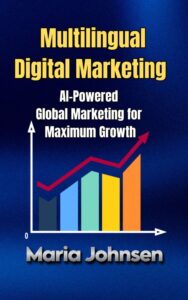 In a world where borders are shrinking and attention spans are global, your business can’t afford to speak only one language. Multilingual Digital Marketing: AI-Powered Global Marketing for Maximum Growth is the definitive guide to connecting, converting, and thriving across international markets. Maria Johnsen shares her multilingual marketing experience in New York, across the U.S., and internationally.