Biocomputing is turning cells, neurons and DNA into machines. Could the next computer be partly alive?
For decades, computing has followed a remarkably consistent playbook: shrink the silicon, make the transistors faster, and squeeze more computing power into less space.
It’s hard to argue with the results. That approach gave us pocket-sized computers, enormous data centres, cloud computing and, more recently, the rapid expansion of artificial intelligence.
But the approach is becoming harder to push forward. AI systems require enormous amounts of computing power and electricity, while the physical limits of conventional chip manufacturing are becoming increasingly difficult to ignore.
So some researchers are looking somewhere rather unexpected.
Instead of building machines that try to imitate biology, what if we used biology itself?
It sounds like the beginning of a science-fiction film. Yet researchers are already growing neural networks on microelectrode arrays, experimenting with DNA as a way to store digital information, and engineering living cells that can detect and respond to specific biological signals.
That doesn’t mean your next laptop will be grown in a petri dish. Biology is fragile, difficult to control and extremely slow compared with modern electronics.
But speed isn’t necessarily the point.
Living systems can do some remarkable things with very little energy. They recognize complicated patterns, adapt to changing conditions and respond to their surroundings in ways that conventional computers have to work very hard to reproduce.
That is where biocomputing gets interesting.
Wiring Up the “Wetware”
Mention biocomputing and it’s easy to imagine a mad scientist connecting a brain to a computer.
The reality is much less dramatic, although it is still pretty strange.
Scientists can grow living neurons often derived from stem cells on tiny arrays of electrodes. The electrodes allow researchers to send electrical signals into the cells and record their activity.
A few years ago, researchers at Cortical Labs attracted widespread attention after connecting cultured neurons to a simplified version of Pong. The resulting headlines described it as a “brain playing a video game.”
That’s a fun way of describing it, but it isn’t quite what happened.
The cells weren’t consciously playing Pong. They weren’t thinking about winning or trying to beat a high score. What the experiment demonstrated was that a living neural network could receive information from a digital environment, respond to feedback and change its activity as it interacted with that environment.
That’s where things get interesting.
A Deeper Look at Biocomputing
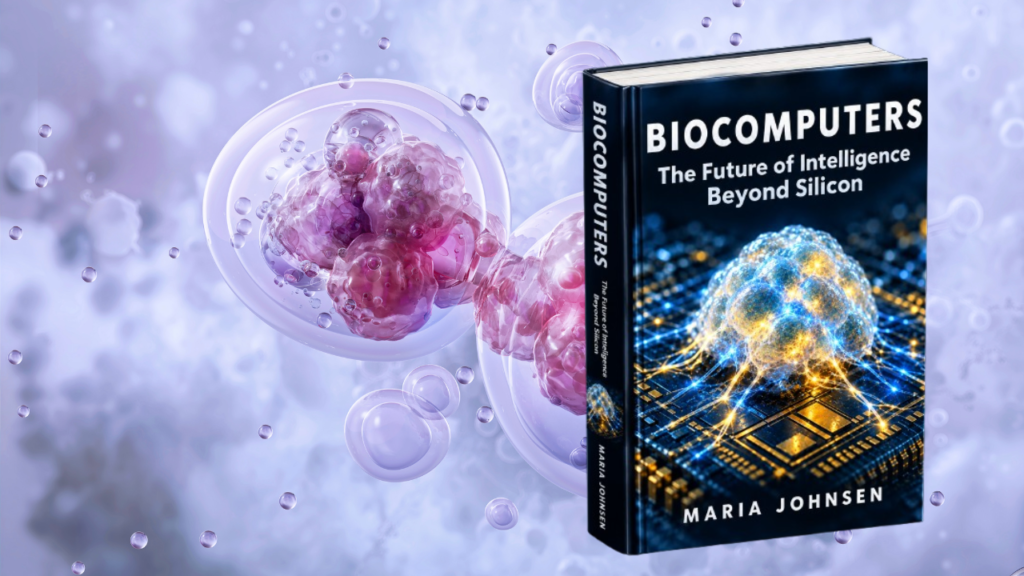
If you want to go beyond the current experiments and look at where this field could lead, I explore the subject in greater detail in my book, Biocomputers: The Future of Intelligence Beyond Silicon.
The book looks at the growing relationship between biology and computing, from biological neural networks and DNA data storage to synthetic biology and the possibility of machines that don’t simply imitate living systems, but actually use them. My article only scratches the surface. The book goes much further into the technology, the challenges researchers face, and what biocomputing could eventually mean for the way we buildand even think about computers.
I wrote it especially for AI companies and researchers who understand how to implement AI safely and have the expertise to take ambitious ideas further. The book gets technical, including mathematical equations, because I wanted to put the actual concepts on the table rather than simply throw around futuristic ideas.
I don’t have a large research lab or a huge technology company behind me and that’s precisely why I’m putting these ideas into a book. A good idea shouldn’t need a billion-pound budget before someone is willing to examine it.
I’m putting the concepts, the technical thinking and the vision in front of the people who have the expertise and resources to test them properly. I’m not asking you to accept everything I propose. Quite the opposite.
Challenge it. Test the equations. Question the assumptions. Build the experiments. Find the flaws. And if you discover something that works, take it further.
If you ask me, my original ideas work. How do I know? Because the people who used them told me so.
My security wheel whitepaper, for example, caught the attention of a cybersecurity company. They implemented the idea and it worked.
Years earlier, when I was heavily involved in SEO, I developed what I called the link wheel SEO ( In English, Norwegian, German, French), a strategy that helped companies improve the ranking of their keywords online.It became popular then other SEOs used my idea started selling link wheel seo and link pyramid to their clients, this is how link wheel got famous back then.
So, yes, I believe in testing ideas in the real world. An idea is only an idea until someone actually builds it, uses it, and finds out whether it works.
Anyway, that’s my two cents.
This book is an invitation to builders: the engineers, scientists, researchers, founders and AI companies willing to explore what computing could become beyond today’s familiar architecture.
I’ve put the ideas on the table. If you have the tools to turn them into reality, I invite you to pick them up and build.
A conventional computer follows instructions. Under the same conditions, the same input should produce the same output. Living neural networks are different. Their activity changes. Connections can strengthen or weaken. The system can adapt to what it encounters.
Researchers aren’t necessarily trying to turn neurons into replacement processors. The more interesting question is whether that ability to adapt could make biological systems useful for particular types of computing.
Packing a Library Into DNA: holy moly!
Neurons aren’t the only biological material attracting attention.
DNA offers a completely different possibility: data storage.
We are producing enormous amounts of digital information. High-resolution video, medical records, scientific research, software, photographs and AI datasets all have to be stored somewhere. Keeping that information available requires vast amounts of conventional storage infrastructure, much of which also needs electricity for operation and cooling.
DNA takes a very different approach.
Digital information can be converted into sequences made from the four chemical bases in DNA: adenine, thymine, cytosine and guanine.
The potential storage density is extraordinary. A tiny amount of DNA can theoretically hold huge quantities of information, which is one reason researchers are interested in it.
DNA also has an advantage for long-term storage. It doesn’t require a continuous electrical supply simply to preserve the information. Under suitable conditions, DNA can remain stable for very long periods.
There is, however, a fairly significant catch.
Reading and writing DNA is still slow and expensive compared with conventional storage. Your SSD isn’t about to disappear.
The more realistic use is archival storage: information that needs to be preserved for a long time but doesn’t need to be accessed every few seconds.
That could include scientific records, historical archives or other large collections of information that may need to survive for decades or longer.
The technology still has substantial technical and economic problems to solve, but researchers are already working on ways to make molecular storage more practical.
Turning Cells Into Living Sentinels? You don’t say!
Then there is synthetic biology.
Scientists can modify living cells with genetic circuits that allow them to respond to particular signals. In simple terms, researchers can give a cell something resembling biological instructions: if it detects a particular molecule, trigger a specific response.
That has obvious possibilities in medicine.
Imagine a biological system that could detect a particular signal associated with a disease, respond to it and potentially release a treatment in the same area.
That is very different from the way many conventional medicines work, where a drug travels through the body and affects multiple tissues.
Engineered cells could eventually offer much more localized ways of sensing and responding to biological problems.
There is a long way to go, though.
Anything involving living cells inside the human body raises difficult questions about safety, reliability, control and regulation. Researchers need to know not only whether a system works, but also what happens when it doesn’t behave as expected.
For now, these technologies remain an active area of research. But the basic idea of using living cells as sensors and biological decision-makers is already being explored in laboratories.
The Reality Check,folks!
This is where the excitement around biocomputing needs a little perspective.
Working with biology is difficult.
A silicon chip doesn’t need food. It doesn’t need to be kept alive. It doesn’t get contaminated, and it can perform the same calculation over and over again with remarkable consistency.
Living cells are much less cooperative.
They need nutrients and carefully controlled conditions. They can behave differently under apparently identical circumstances. They can become damaged, contaminated or simply stop behaving as expected.
Then there is the problem of biological noise.
Computer engineers normally try to reduce unwanted variation. Biology is full of it. Two cells can respond differently to the same stimulus, and neural activity can fluctuate constantly.
From an engineering perspective, that sounds like a problem.
But the human brain gives us an interesting counterexample. It works with incomplete information, constantly changing conditions and plenty of biological variability. Yet it can recognize a face, learn from experience and adapt to situations it has never encountered before.
So perhaps the goal isn’t to eliminate all of that biological noise.
Perhaps the goal is to understand when it can actually be useful.
Where Silicon and Biology Meet
None of this means silicon is going away.
For calculations, communication, conventional software and countless other applications, modern electronics are extremely good at what they do. They are fast, reliable and capable of being manufactured on a scale that biological computing cannot currently match.
The more realistic possibility is that the two approaches eventually work alongside each other.
Silicon could continue handling high-speed calculations and conventional computing tasks, while biological systems could be used in areas where their ability to adapt, sense their environment or store information at the molecular level gives them an advantage.
That would be a fairly significant change in the way we think about computing.
For decades, we have looked at nature and tried to reproduce what it does using machines. Neural networks borrowed ideas from the brain. Robotics has borrowed ideas from animals. Computer vision tries to reproduce abilities that biological systems perform naturally.
Now researchers are beginning to explore another possibility.
Maybe we don’t always have to imitate biology.
For some problems, perhaps we can use it.
We’re still a long way from knowing how practical that will become. But the experiments happening today suggest that the boundary between computing and biology may become considerably less clear in the years ahead.