
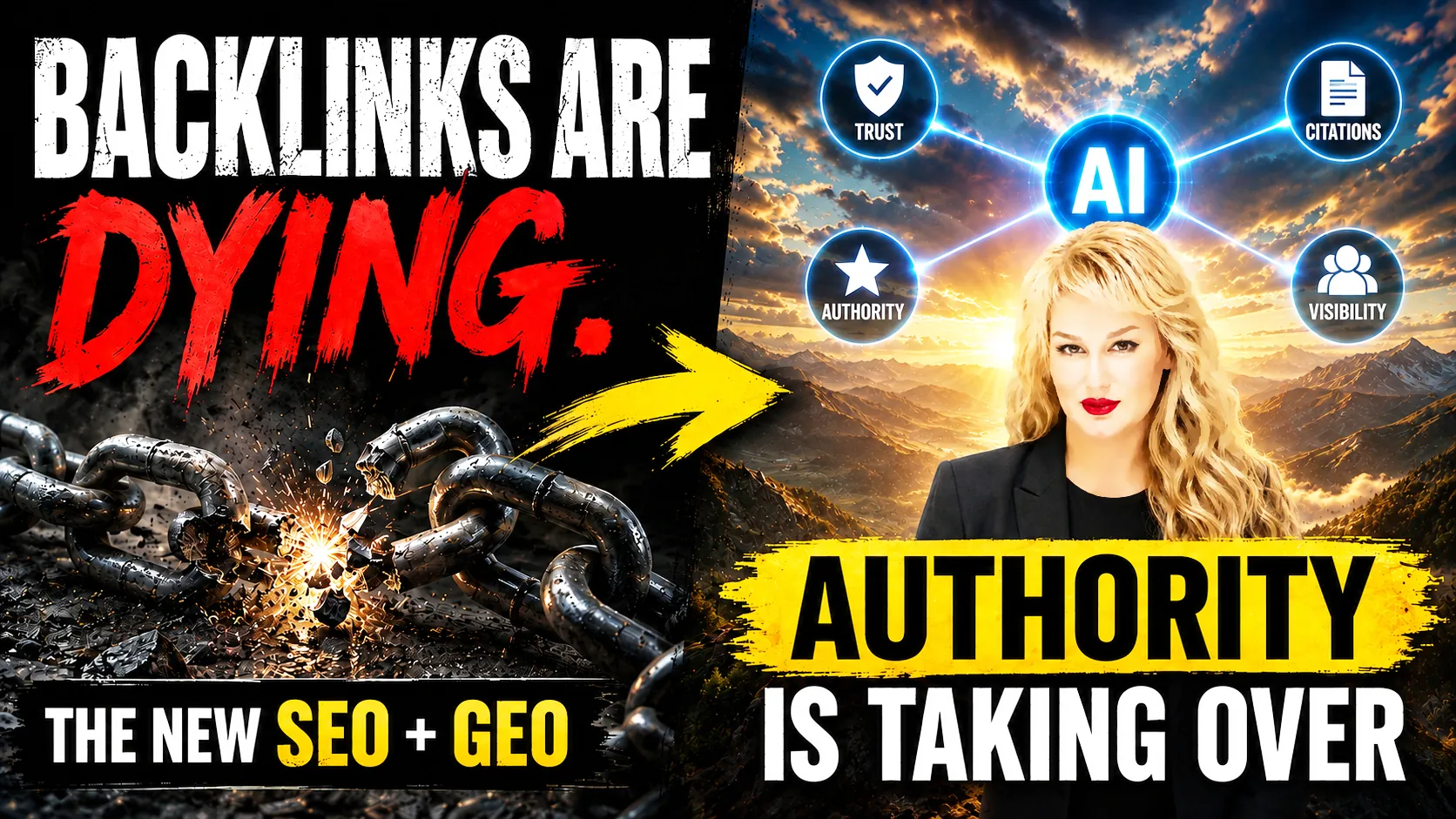
Link building SEO still matters in the AI era, but quality, authority, relevance, and genuine mentions now matter more than volume. In the past, SEO followed a simple formula: publish content, target keywords, build backlinks and climb Google’s rankings. The more links you collected, the better or at least that was the theory.
Today, that approach is becoming dangerously outdated.
Link building is not dead. But the old obsession with accumulating as many backlinks as possible is losing its value. The future belongs to websites, creators and brands that build something far more difficult to fake: authority, relevance and recognition across the web.
The biggest shift is this:
Link building is no longer just an SEO tactic. It is becoming an authority and discovery strategy.
Google still uses links to discover pages and understand relevance. But search is no longer limited to ten blue links. AI-powered search systems are increasingly selecting, summarizing and citing information based on a much broader set of signals.
The question is no longer simply:
“How many websites link to you?”
Increasingly, the important questions are:
- Is your content directly relevant to the topic?
- Is your information trustworthy and specific?
- Is your work mentioned by independent sources?
- Can an AI system easily extract useful evidence from your page?
- Is the information current?
- Does the web recognize you as a genuine entity in your field?
That changes everything.
The Death of the 5,000-Backlink Strategy
Imagine two websites.
The first has 5,000 backlinks from random blogs, directories, low-quality guest posts and pages created mainly to manipulate rankings.
The second has 20 genuine mentions from respected websites directly connected to its subject.
Under the old mindset, many SEO agencies would focus on the first website’s numbers.
In the new search environment, the second website may have something much more valuable: contextual authority.
A relevant mention in a fantasy publication, a respected film website, an author interview, a legitimate podcast or an independent review can do more than pass a traditional SEO signal. It helps establish who you are, what you do and why your work matters.
That is especially important in the era of Generative Engine Optimization, or GEO.
AI search engines such as ChatGPT, Gemini, Perplexity and Google’s generative search features are trying to answer questions, not merely rank webpages. To do that, they need sources that are relevant, understandable and credible enough to support an answer.
This is why the future is moving away from:
Build links → increase metrics → rank higher
And toward:
Create authority → earn mentions → become recognizable → get discovered and cited
SEO Is Not Dead. It Is Expanding.
The mistake is assuming that GEO replaces SEO.
It doesn’t.
SEO is evolving.
Traditional SEO still matters because search engines still need to crawl, understand and index your content. Keywords still help establish relevance. Technical SEO still helps search systems access your pages. Strong content still gives algorithms something valuable to rank or cite.
But the strategy is becoming much larger.
The modern visibility equation looks more like this:
SEO + GEO + Entity Authority + Citations + Brand Recognition
Your website is no longer the only place where your authority is measured. The wider web matters.
Can independent sources connect your name to your work?
Do other websites discuss your projects?
Are you mentioned in relevant communities?
Does a consistent information trail exist across publications, interviews, reviews, databases, videos and other credible sources?
That is where entity building becomes incredibly powerful.
Build a Reputation, Not a Backlink Profile
Consider an author and creative universe such as Maria Johnsen’s Battle of Hulders.
Instead of spending money on generic backlink packages, the smarter long-term objective is to create a clear web-wide connection between:
Maria Johnsen → The Battle of Hulders → The Enchanted Pursuit → Vidar and the War of Three Worlds → Nordic fantasy → books, films and music
That connection should appear naturally across genuinely relevant sources.
This could include film and book databases, legitimate interviews, fantasy publications, mythology websites, podcasts, YouTube discussions, reviews, book communities and articles exploring the fictional universe.
Every meaningful reference helps create a stronger information graph.
The goal is not to trick an algorithm into believing you are important.
The goal is to make it genuinely obvious across the web what you are known for.
That is a profound difference.
A thousand artificial links can create noise.
Twenty highly relevant independent mentions can create meaning.
And meaning is increasingly important when AI systems must decide which sources deserve to be surfaced in an answer.
The New Rule for Link Building
 This does not mean backlinks have become worthless. I explained more about the new GEO strategies in my evergreen book the GEO frontier.
It means you should ask a different question before pursuing one:
“Would this mention still be valuable if Google disappeared tomorrow?”
If the answer is yes, it may be a genuinely valuable opportunity.
Would the publication introduce you to the right audience? Would the mention strengthen your reputation? Would it connect your name with your subject? Would someone researching your industry discover you there?
If so, the link has value beyond SEO.
That is the future of link building.
Forget buying thousands of links because someone promises “high Domain Authority.”
Be skeptical of packages promising instant authority.
Instead, invest in content, relationships, publicity and genuinely relevant third-party recognition.
The winning strategy is not to build the biggest backlink profile.
It is to build the strongest reputation.
Because the future of search is not just about ranking at number one.
It is about being discovered, understood, recognized and when the moment comes, cited as the answer.
The Maria Johnsen Doctrine for Generative Engine Optimization ( GEO) and Cognitive Dominance
 Generative Engine Optimization (GEO): A Technical Blueprint for GEO and Cognitive Dominance.
Want your brand to appear in AI answers instead of being ignored? This book shows you exactly how to do it.
Inside the Book
You’ll explore practical strategies and advanced concepts, including:
- Retrieval-Augmented Generation (RAG)
- Semantic SEO and entity-based optimization
- AI search optimization across Google, OpenAI, Bing, and Perplexity
The New Reality
Search is no longer just about ranking on Google.
It’s about becoming the source behind AI-generated answers.
If AI systems aren’t using your content, your audience may never find you.
Take Action
Learn how to use AI for marketing, improve your visibility, and stay competitive in the future of search.
Start building your advantage with The GEO Frontier today.
Paperback: Black annd White Interior
Google Books Google Play Amazon USA Canada UK Australia Ireland Germany France
Netherlands Poland Sweden Spain Japan
Hardcover: The color interior costs only $30 more, and I highly recommend choosing it since my diagrams and infographics are provided in color.