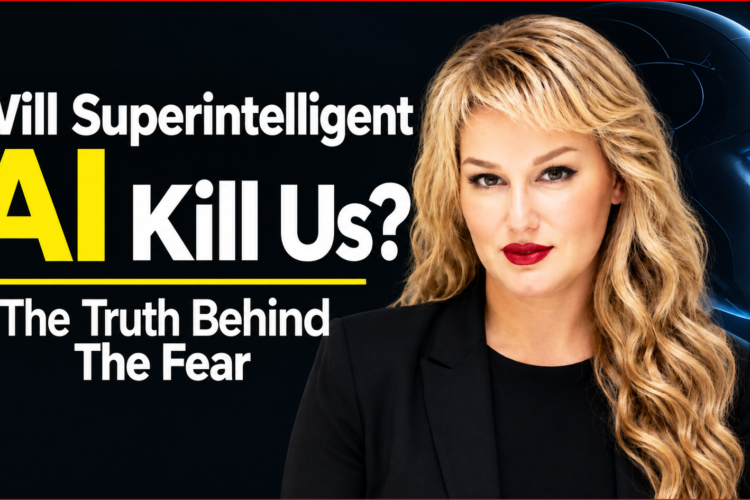
Why Does AGI Fear Spread So Fast Online? The Truth Behind AI Anxiety
Why does AGI fear spread so quickly online? From alarming headlines about superintelligence to predictions of job losses and existential risks, artificial general intelligence has become a major source of public anxiety. Understanding the psychology behind AI fear can help us separate genuine risks from speculation and prepare for the future more rationally.
Why Is Everyone Afraid of AGI?
Artificial general intelligence (AGI) is a hypothetical form of AI capable of performing a wide range of intellectual tasks at a level comparable to humans. Although experts disagree about its definition, development timeline, and potential consequences, the subject has attracted enormous public attention.
Much of that attention is driven by fear.
Some people worry that AGI could replace human workers, concentrate economic power, undermine privacy, or become difficult to control. Others imagine scenarios in which advanced AI systems pose a threat to humanity itself.
These concerns vary in their evidence and likelihood, but they share one important feature: uncertainty about the future.
Human beings naturally pay attention to potential threats. When a new technology could transform society, our minds often focus on what might go wrong before considering the full range of possible outcomes.
Social media intensifies this tendency by making dramatic claims easy to distribute and emotionally charged discussions difficult to ignore.
How Social Media and AI Headlines Amplify Fear
One reason AGI fear spreads so quickly online is that alarming content can attract more attention than balanced analysis.
A headline about AI improving medical research may be interesting. A headline suggesting that AI could make humans obsolete creates a more immediate emotional reaction.
This difference matters in an online environment where attention is valuable.
Sensational claims can spread rapidly, particularly when they present uncertain predictions as urgent warnings. Repeated exposure can also make a possibility feel more likely, even when the underlying evidence has not changed.
However, not every warning is sensationalism. Researchers have identified legitimate concerns involving AI misuse, security vulnerabilities, misinformation, and the challenges of maintaining effective human oversight as systems become more capable.
The key is to evaluate each claim individually rather than accepting or rejecting all AI warnings as a group.
A responsible discussion of AGI should distinguish scientific evidence, expert disagreement, reasonable forecasts, and speculative worst-case scenarios.
What AGI Headlines Often Leave Out
Public discussions frequently treat current AI capabilities and hypothetical future AGI as though they were the same thing.
They are not.
Today’s AI systems can perform increasingly sophisticated tasks, but impressive performance in particular areas does not automatically establish the existence of general intelligence in every relevant sense.
Similarly, predictions about future systems depend on assumptions about technological progress, computing resources, research breakthroughs, and the ability to overcome existing limitations.
There is no universally agreed timeline for achieving AGI, and claims of certainty should be approached cautiously.
The potential risks also deserve careful examination. Some could emerge through deliberate misuse or economic disruption. Others concern whether increasingly autonomous systems can be reliably evaluated, controlled, and aligned with human intentions.
Understanding these differences helps prevent two common mistakes: dismissing legitimate risks because some predictions are exaggerated, and assuming that the worst imaginable outcome is inevitable because it is possible.
Why Fear Is Not the Same as AI Safety Preparation
Fear can draw attention to a problem, but it is not a substitute for solving it.
Preparing for advanced AI requires practical work, including technical safety research, independent evaluations, cybersecurity protections, appropriate regulation, and accountability for organizations developing and deploying powerful systems.
It also requires cooperation among researchers, governments, businesses, and the wider public.
Effective preparation begins by asking specific questions. What could go wrong? Under what conditions? How serious would the consequences be? What evidence supports the concern? Which safeguards could reduce the risk?
These questions lead to better decisions than simply repeating predictions about a future in which everything goes wrong.
At the same time, optimism should not become an excuse for complacency. Potentially transformative technologies deserve careful evaluation before their consequences become difficult to manage.
The goal is neither blind confidence nor constant alarm. It is evidence-based preparation.
How to Stay Informed About AGI Without Anxiety
You can follow AI developments without allowing them to dominate your thoughts or daily routine.
Start by choosing reliable sources that explain the underlying research rather than focusing exclusively on dramatic predictions. When possible, read original research or compare several credible interpretations of the same development.
Next, learn to distinguish between three important concepts:
Possibility: An outcome could occur under certain conditions.
Probability: The available evidence suggests how likely that outcome may be.
Certainty: An outcome is established or unavoidable.
These concepts are not interchangeable. A possible catastrophe is not necessarily a probable one, and uncertainty does not mean that a risk should be ignored.
It is also worth limiting repetitive exposure to alarming content. Following a small number of reliable sources and checking updates at reasonable intervals can provide a clearer picture than constantly scrolling through predictions and reactions.
Finally, focus on what you can influence. Learn how AI works, develop skills that remain valuable as technology changes, support responsible innovation, and participate in informed public discussions.
Staying informed should increase your understanding, not leave you feeling helpless.
Could AGI Benefit Humanity?
Although much of the public conversation focuses on danger, advanced AI could also create significant opportunities.
If AGI becomes achievable and can be developed and deployed safely, it might help accelerate scientific research, improve medical discoveries, support personalized education, and assist with complex engineering and environmental challenges.
It could also transform many industries and change the nature of work.
However, these benefits are not automatic. Their realization would depend on the reliability of the systems, how their capabilities are governed, who can access them, and how the resulting economic and social changes are managed.
Potential benefits and potential risks should therefore be examined together.
A mature understanding of AGI recognizes that technological progress can create extraordinary opportunities while also introducing problems that require deliberate solutions.
Understanding AGI Is Better Than Fearing the Unknown
AGI fear spreads online because uncertainty, dramatic predictions, and human psychology create a powerful combination. Social media can amplify that combination, making the most frightening possibilities appear more immediate or inevitable than the evidence warrants.
Yet dismissing every concern would be just as unhelpful as believing every alarming prediction.
The better response is to understand the technology, evaluate evidence carefully, take credible risks seriously, and support responsible AI development.
We cannot predict every consequence of AGI, but we can improve our ability to respond to emerging challenges. We can also recognize that the future will be shaped by human decisions, not simply by technological capabilities.
Understanding AGI does not mean assuming everything will turn out well. It means preparing intelligently without allowing fear to replace reason.
The future of artificial intelligence deserves serious research, thoughtful public debate, and responsible action. Above all, it deserves a conversation driven by evidence rather than panic.